A new and unique method of translation that brings you a literal and faithful word-for-word translation of the Hebrew text through the English language.
Genesis Chapter 1
1 in~SUMMIT (בְּרֵאשִׁית / bê'rey'shit)[1]
he~did~SHAPE(V) (בָּרָא / ba'ra)
Elohiym (אֱלֹהִים / e'lo'him)
AT (אֵת / eyt)
the~SKY~s2 (הַשָּׁמַיִם / ha'sha'ma'yim)
and~AT (וְאֵת / wê'eyt)
the~LAND (הָאָרֶץ / ha'a'rets) RMT: In the summit Elohiym shaped the skies and the land,
2 and~the~LAND (וְהָאָרֶץ / wê'ha'a'rets)
she~did~EXIST(V) (הָיְתָה / hai'tah)
CONFUSION (תֹהוּ / to'hu)
and~UNFILLED (וָבֹהוּ / wa'vo'hu)
and~DARKNESS (וְחֹשֶׁךְ / wê'hho'shekh)
UPON (עַל / al)
FACE~s (פְּנֵי / pê'ney)
DEEP.WATER (תְהוֹם / tê'hom)
and~WIND (וְרוּחַ / wê'ru'ahh)
Elohiym (אֱלֹהִים / e'lo'him)
much~FLUTTER(V)~ing(fs) (מְרַחֶפֶת / mê'ra'hhe'phet)
UPON (עַל / al)
FACE~s (פְּנֵי / pê'ney)
the~WATER~s2 (הַמָּיִם / ha'ma'yim) RMT: and the land had existed in confusion and was unfilled, and darkness was upon the face of the deep water and the wind of Elohiym was fluttering upon the face of the waters,
3 and~he~will~SAY(V) (וַיֹּאמֶר / wai'yo'mer)
Elohiym (אֱלֹהִים / e'lo'him)
he~will~EXIST(V) (יְהִי / yê'hi)
LIGHT (אוֹר / or)
and~he~will~EXIST(V) (וַיְהִי / wai'hi)
LIGHT (אוֹר / or) RMT: and Elohiym said, light will exist, and light existed,

Reviews
 Myrtle Lim: Readable and simple to understand Myrtle Lim: Readable and simple to understand
Eric John Nagel: This has been a wonderful tool that I have used ever since the first edition and even perhaps the rough draft, I think I even helped edit some. Now I am joyful that I can use it online and through the entire Torah. Blessings, eric
Wesley 'Ley' Rose: My friend Mr Brenner has added a new dimension of thought, understanding, and value to Biblical Hebrew study. His careful inspection and diligent adherence
to the Hebrew structure and depth of the Hebrew language have prooved an excellent transliteration / translation of what some
scholars considered a dead language. It comes alive with vibrant meaning and proves to be a treasure worth looking into. Do
yourself a favor, take the time to examine this fresh look at ancient Hebrew and it's Biblical view reevaluated and redefined.
Get the Book
 |
|
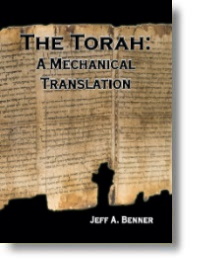
The Torah: A Mechanical Translation
Details and Ordering
This translation of the Torah will allow a reader, who has no background in Hebrew, to see the text from a Hebraic perspective, without the interjection of a translator’s theological opinions and bias. This translation style is also a useful tool for those who are learning to read Biblical Hebrew.
|
Mr. Benner's On-Line Courses

How to do a Hebrew Word Study |
|
Learn to Read Biblical Hebrew |
|
Learn Ancient Hebrew |
|